Quintessential Quito

September 6, 2016

Quito, the capital of Ecuador, initially reminded me of the large Colombian cities of Bogota and Medellin.  This was due more to the common look of these big South American cities (i.e. dense and sprawling concrete buildings, packed through a long valley, with neighborhoods pushed to the city’s geographical boundaries, and terraced up the mountain sides), than the spirit of each specific destination.  And I will let you know, Quito is very special.  In my opinion, this city has one of the most beautifully maintained, historical centers of any I have had the pleasure of exploring, in ALL my Latin American travels.  It is unique for its contemporary mixture of indigenous culture and Spanish colonial artistry, both honored for their contribution to the Quiteno lifestyle.

Continue Reading…

Encountering Ecuador

September 2, 2016

We came to Ecuador, our last country on nearly a year of travel, with zero plans.  I had not even begun to read our guidebook on this destination until we were on a bus within its perimeter. Our border crossing and subsequent onward transportation plans fell on a holiday (unbeknownst to ourselves) which meant that our first impressions of general organization when buying a bus ticket were dismally low.  Standing in long lines for over an hour, with equally frustrated and anxious travelers, mired in confusion about IF the queue was the “right” one to begin with, didn’t get us off to a great start. We were starting to panic that we might not even get out of Ecuador’s questionable border town and on our way to Otavalo that same evening. Thankfully, we eventually garnered tickets at at least three times the price we had been used to paying in Colombia, and made it to our destination in the dark of night.  Dropped off on the side of the highway, we cautiously crossed into what appeared to be the direction of the city, starving for some sustenance and assurance of safety.

Continue Reading…

Our Final Week in Colombia

August 30, 2016

San Agustin, what a pleasure this destination proved! This town which is located in the department of Huila, Colombia, is well-known for its pre-Columbian archeological sites (or so the inter web claims). In truth, I am shocked by how little we knew about this destination in advance of our visit.  My education of South and Central American ancient cultures has focused on the Incans, Mayans and Aztecs, completely passing over the contributions of lesser studied people like the Augustine master carvers of the 8th to 1st century BC. Not much is known about this civilization, other than what can be interpreted by their monolithic stone sculptures, ceremonial and burial grounds, ceramics, goldsmithing and agricultural sites. Myths abound about the variety of images carved into volcanic rock, which consist of animals or humans, with smiling or serious and scary, fanged faces, holding warrior implements or babies (little people?), and often featuring anthropomorphic animal features, like jaguar eyes. The lush, green mountains and valleys are a literal treasure trove of buried ruins, with about 600 known large sculptures and 40 burial mounds in the Alto Magdalena Region.  Almost half of these impressive works can be visited in one go, at the San Agustin Archeological Park.

Continue Reading…

Passing through Popayan

August 17, 2016

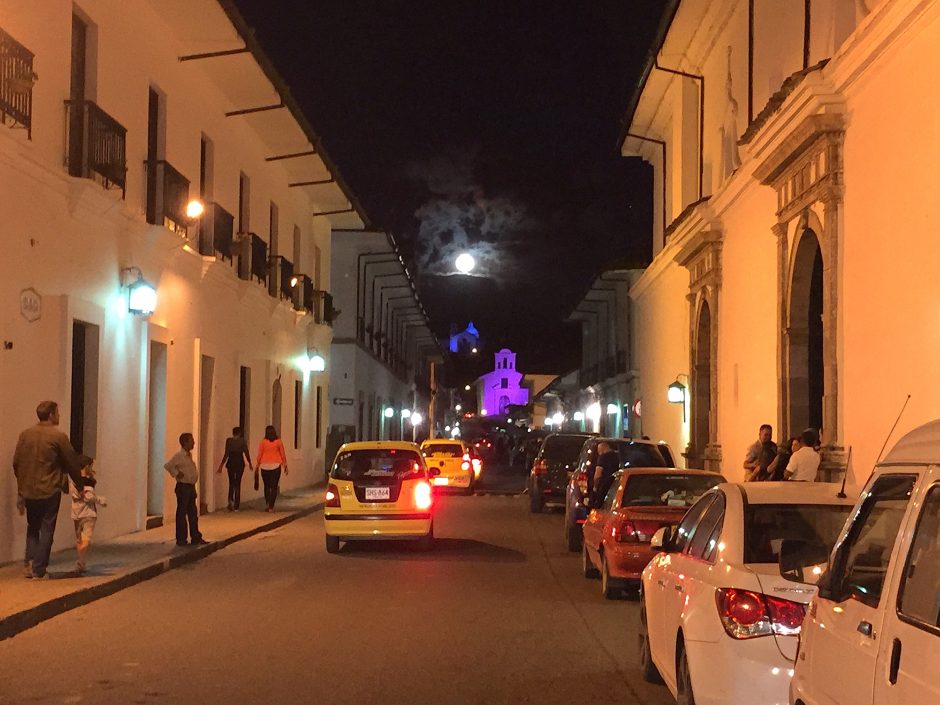
Popayan was a pleasant surprise, due to its Spanish colonial beauty.  In the Southern Colombian department of Cauca, Popayan is this region’s white-washed capital, and a distinguished university town. Arriving by bus into the outskirts of the older center, we had no idea what a visual treat we were in for.  A short taxi ride later and we entered the “white city” with its many elaborate churches, cathedrals, shady plazas, pedestrian lanes, and historical museums. On our first evening, we discovered a perfect little Italian restaurant, with fresh pesto sauce and unctuously crisp and chewy pizza crust that twice fulfilled our pasta & pie longings.  We also sampled more Colombian coffee and street food, including papas rellenas, which are balls of mashed potatoes filled with a variety of savory ingredients, like meat, eggs, and cheese, then deep-fried and served for breakfast with a spicy aji sauce.

Continue Reading…

Coming to Cali

August 15, 2016

If you have heard of Cali, then you know that it is famed for its salsa music and dancing clubs. I won’t be able to tell you anything about either of these aspects. You may have even seen Anthony Bourdain’s “Parts Unknown” show on Colombia, and learned about tejo, the sport of throwing a metal puck at an exploding target encased in clay, within a protective frame 20 meters away. I can’t tell you anything about this activity either. This is an example of how ‘traveling with kids’ can prevent you from experiencing certain parts of a culture. Thankfully, we were not coming to Cali to partake in the above adventures (I lie to myself), but rather to visit some American friends and meet their brand new baby boy.

Continue Reading…

Colombia for Art Lovers

August 13, 2016

Once again, I am drawn to the art museums, which represent a study in the culture and relevant topics of a country.  In Colombia, much of the art we see is colorful and playful. There are definite influences from Spanish colonialism, but art is also firmly rooted in the political and societal present, as interpreted by the artist.  The slide show below only represents my personal favorites – those artworks that captured my interest. These paintings and sculptures were viewed in two museums: Museo de Antioquia in Medellin, which predominantly features the artwork of native painters, Fernando Botero and Pedro Nel Gomez, and La Tertulia Museum of Modern Art in Cali, which consists of three buildings, one housing a gallery of over 300 native and international works. Here we watched a contemporary artist, Jose Horacio Martinez, actually paint on canvas, in an ongoing installation, adding detailed layers to works in progress, including the walls of the museum. I really enjoyed his bright, abstract art and use of color, which featured both loose & fluid and intricate brush strokes (his work is found in the last seven images in this slide show). Notable in Botero’s work, which depict voluminously, large figures, are paintings of Pablo Escobar’s death. Disfruta!

Continue Reading…